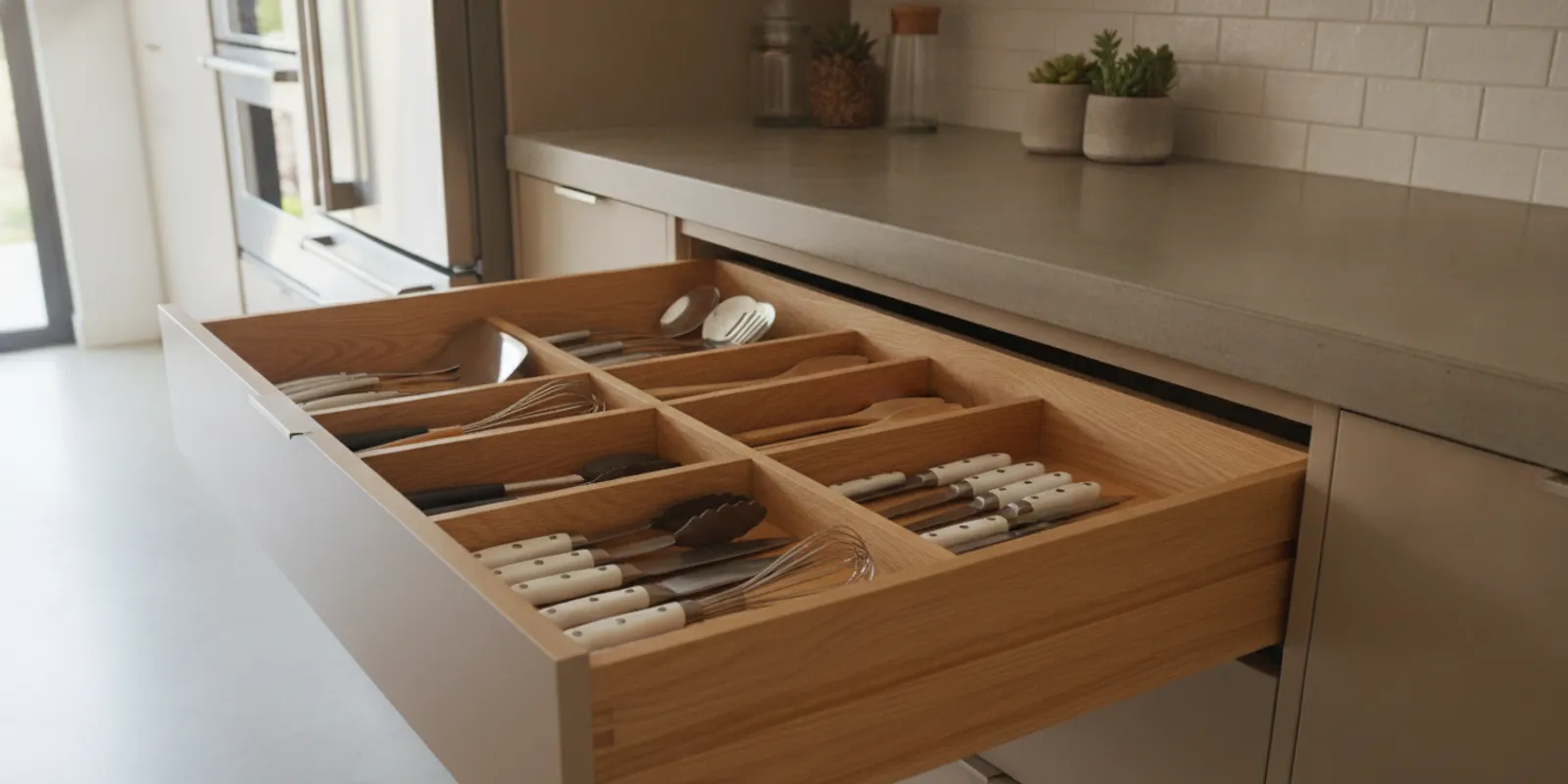
Good kitchen drawer organization ideas start with the way you cook, not with a shopping list of organizers. In a remodel, the drawer plan can be built around the tools you reach for, the work areas where you use them, and the cabinet space available. With a little planning before cabinetry is finalized, everyday items can have a predictable place and busy counters can stay clearer.
Call to discuss your kitchen remodel
What should you decide before planning kitchen drawers?
Begin by observing your current routine. For several days, notice where you stand to prep food, cook, serve, and clean up. Pay attention to items that migrate from drawer to counter because the storage location is inconvenient. Also note drawers that are crowded, difficult to open fully, or holding things you rarely use.
Make a simple inventory, grouping objects by task rather than by material. A prep group might include measuring spoons, a peeler, and a small knife. A cooking group might include spatulas, tongs, and a thermometer. Serving tools, wraps, and food-storage containers may each need their own homes. Write down the items you use every day separately from occasional tools, such as a roasting rack or specialty pastry cutter.
Do not assume every object needs to stay in a drawer. Tall bottles, a countertop appliance, or bulky pots may fit better in a cabinet or pantry. The goal is not to put the maximum number of things into drawers. It is to make the useful things easy to find without creating a crowded, hard-to-maintain system.
Before design decisions are fixed, take measurements of the actual objects you want to store. Include the length of handles, the height of stacked containers, and any awkward shapes. For items you expect to buy later, use the dimensions on the product specification rather than relying on a general category name. Record which items need to be grouped and where in the room you use them.
How can you divide the kitchen into useful storage zones?
Zones connect storage to activity. A drawer near the main prep surface can hold knives and measuring tools. Drawers beside the range can serve cooking tasks, while a drawer near the dishwasher can hold flatware or items used to set the table. Keep frequently used objects close to where the task happens, but leave enough clear space for safe movement and for doors and drawers to open.
- Prep zone: Keep measuring tools, peelers, a can opener, and prep utensils near the surface where you chop and mix.
- Cooking zone: Place heat-safe utensils, potholders, and frequently used cooking tools close to the range, away from heat and splashes.
- Dish and cleanup zone: Store flatware, towels, or dish-care items near the sink or dishwasher, with cleaning products kept safely separate from food-contact items.
- Serving zone: Group serving spoons, trivets, and the tools used to set the table near the dining or serving area.
- Food-storage zone: Keep wraps, bag clips, and container lids together near the refrigerator or the place where leftovers are packed.
A zone does not have to mean a dedicated cabinet for every task. In a compact kitchen, the same drawer can serve two related activities if its contents remain easy to distinguish. For example, one drawer may hold cooking utensils in a long compartment and measuring tools in a smaller section. Avoid mixing unrelated categories simply because they happen to fit.
Consider who uses the kitchen. If children help set the table, put safe, everyday items within their reach and keep sharp tools elsewhere. If more than one person cooks, agree on the locations before the remodel is complete. A system that makes sense to only one person is harder for the whole household to maintain.
Which drawer sizes work for common kitchen items?
Drawer dimensions should follow the objects and tasks, not a universal rule. A shallow drawer can make small items visible, while a deep drawer can accommodate taller objects or stacks. The usable interior is smaller than the cabinet opening because the drawer sides, bottom, hardware, and clearances take up space. Ask for the usable inside dimensions of the planned drawer and compare those with your inventory before approving the layout.
Think in three broad groups. Shallow drawers are useful for flatware, measuring spoons, and small tools that are easy to lose in a deeper space. Medium-depth drawers suit many everyday utensils, towels, wraps, and small kitchen tools. Deep drawers can work for pots, mixing bowls, or storage containers, provided the items are not piled so high that retrieving one becomes a chore.
Width matters as much as depth. A wide drawer gives room to spread out tools, but it can also become an undivided catch-all. A narrower drawer can keep one category contained, although too many narrow drawers may limit flexibility. A practical plan can combine drawer widths: reserve a wide drawer for a clearly defined group, and use smaller drawers for categories that benefit from separation.
Also check clearance around handles, adjacent cabinet doors, appliances, and walkways. Make sure a fully extended drawer will not collide with an oven door or block the path through the kitchen. Corner areas and islands may offer useful storage, but their exact shape can affect what fits and how easily it can be reached.
| Drawer type | Common uses | Planning check |
|---|---|---|
| Shallow | Flatware, measuring tools, small utensils | Confirm dividers fit and items are easy to lift out. |
| Medium-depth | Cooking tools, wraps, towels, small gadgets | Check the height of handles and organizer compartments. |
| Deep | Pots, bowls, containers, or bulky tools | Test access to items at the bottom and avoid excessive stacking. |
| Wide | Grouped tools or larger cookware | Plan internal divisions so the contents do not spread or jumble. |
This is a planning comparison, not a standard dimension chart. Cabinet construction and hardware affect the interior space, so confirm dimensions with the design before ordering inserts or finalizing drawer fronts. If you are comparing a full kitchen redesign with smaller updates, the kitchen remodeling planning guide can help you organize decisions and project priorities.
How should you choose drawer inserts and dividers?
Start with the shape and quantity of what the drawer will hold. An insert should separate items without forcing them into a tight fit. Leave enough room to lift objects out, especially for utensils with broad handles or tools that need to lie flat. If an insert takes up nearly all the drawer, it may reduce useful space instead of improving it.
Adjustable dividers are useful when contents may change. They can separate utensils from measuring tools or keep pot lids from shifting, and the compartments can be altered as needs evolve. Fixed organizers create a tidy, repeatable arrangement when the contents are stable. Either approach can work; the right choice depends on how often the category changes and how specifically the compartments match the objects.
Consider a few common insert types:
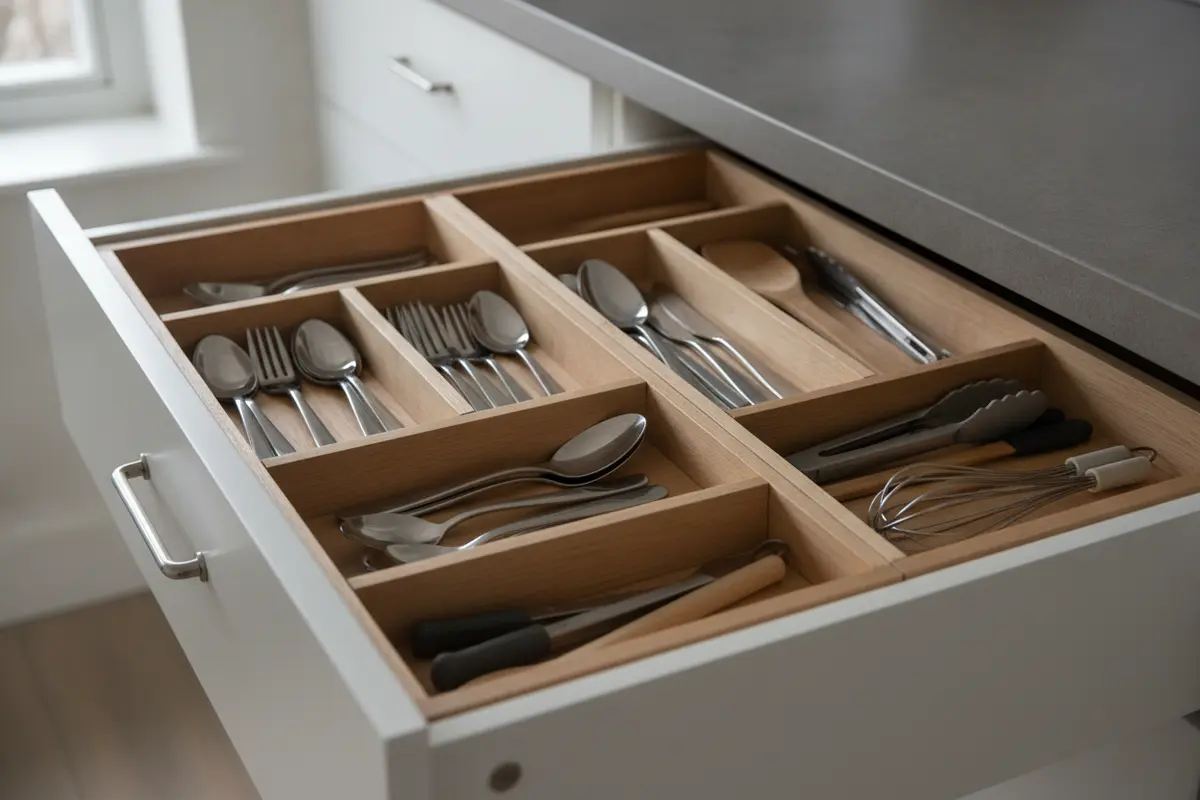
- Flatware trays: Separate forks, spoons, and knives by type. Check that the tray fits the drawer with enough clearance to open and close smoothly.
- Utensil dividers: Keep spatulas, ladles, whisks, and tongs from forming one tangled pile. Long compartments should match the length of the tools.
- Knife storage: Use a suitable in-drawer block or another secure arrangement designed to protect blades. Keep knives out of reach of young children.
- Container-lid organizers: Store lids upright or in a separated compartment so they can be matched with containers without emptying a stack.
- Adjustable pegs: Help contain dishes, bowls, or cookware in a deep drawer. Check that the pegs will work with the shapes and sizes you own.
- Small-item trays: Keep clips, small measuring pieces, and other tiny tools from disappearing under larger items.
Removable organizers are convenient to take out for cleaning and can be replaced if your needs change. Built-in partitions may use space efficiently but are less adaptable. Before choosing, ask how the organizer is secured, whether it can be lifted out, and whether it leaves any difficult-to-clean gaps.
Material is a practical choice as well as a visual one. Wood can complement cabinetry and provide sturdy compartments. Plastic may be easy to remove and wipe down. Metal organizers can suit narrow spaces or specific tool shapes. Look for smooth surfaces and a design that is simple to clean. Do not choose an insert solely because it looks attractive in a photograph; check its actual dimensions against the drawer and its contents.
What belongs in a drawer, and what belongs elsewhere?
Drawers are often best for objects that are used frequently, can lie flat or fit in a compartment, and are easy to retrieve from above. Cabinets may be a better home for tall bottles, bulky appliances, or objects that need vertical clearance. Pantry shelves can be more convenient for dry goods, while a countertop may suit an appliance used daily if it does not interfere with prep space.
For cookware, compare the effort of lifting a heavy pot from a low cabinet with the space a deep drawer requires. Deep drawers can make cookware visible and accessible, but large pots still need a safe, manageable lift. A stack of nested pans should not be so high that the top item blocks access to the rest. Use a lid divider or an adjustable organizer if lids tend to topple.
For food containers, decide whether the containers or lids should be easiest to reach. Keeping lids upright in one compartment can make matching easier, while nesting containers by size can reduce clutter. Check the height of the tallest container against the drawer interior. If you store containers in a cabinet instead, keep them close to the place where leftovers are packed.
Think carefully about items that are rarely used. Seasonal baking tools, specialty serving pieces, and duplicate gadgets may take valuable space from everyday items. If they remain in the kitchen, place them in a less convenient location. The prime drawers should earn their space by supporting daily work.
When the kitchen is part of a broader update, link storage decisions to the entire room plan. Browse kitchen and bath remodeling project examples for ways cabinetry can relate to the overall design, and explore the San Diego kitchen and bath showroom when comparing material and finish options.
How can you keep drawers organized after the remodel?
A useful system should be easy to restore after a busy meal. Give each category enough room to return items without careful stacking. Put the most-used objects in the easiest-to-reach section. If a tool repeatedly ends up in a different drawer, that may be a sign that its assigned location is inconvenient or its category is too broad.
Use labels temporarily while household members learn the new arrangement. Labels are especially helpful for shared kitchens or drawers with multiple sections. After the system becomes familiar, keep labels only where they continue to help. Avoid labeling every individual utensil if that makes the drawer feel more complicated than it needs to be.
Review drawer contents occasionally. Remove broken tools, duplicates, and objects that no longer support the way you cook. Revisit an organizer when categories change, such as when a new set of containers replaces mismatched ones. A quick review can prevent the drawer from becoming a holding place for unrelated items.
Cleaning is easier when inserts can be lifted out and the drawer can be wiped. Follow the care guidance for the drawer finish and organizer material. Keep moisture from lingering in the drawer, and do not store wet tools until they are dry. For sharp tools, maintain a secure storage method and keep safety in mind when reorganizing.
What cabinetry decisions affect drawer organization?
Organization is shaped by the cabinet plan, not only by the insert. The number of drawer fronts, the location of the drawer stacks, and the interior construction determine what can be stored and how it can be reached. Decide what matters most before selecting decorative details. A beautiful cabinet can still be frustrating if the drawers are too shallow for the items you own or placed far from the work area where you use them.
Ask to review the layout at a practical level. Identify the drawers for prep, cooking, cleanup, and serving. Compare the intended interior dimensions with your inventory. Check whether drawers can open fully when nearby doors or appliances are in use. Ask how drawer hardware and construction affect the usable space, and discuss what happens at corners or around an island.
Think about whether the plan leaves room for future changes. A drawer with adjustable dividers may be more adaptable than a tightly fitted compartment. If your household’s cooking routines are changing, avoid designing every inch around a temporary set of gadgets. Conversely, if a category is stable and important, giving it a dedicated place can make daily use simpler.
A remodeling process that combines planning, material selection, and construction can help keep those decisions connected. Learn how King Remodeling’s project process is organized, or review its kitchen remodeling services as you consider the scope of an update. King Remodeling describes its work as an integrated design-build approach; discuss the specific cabinetry and storage details for your home during planning.
What should you ask before approving a drawer plan?
Bring your inventory and room measurements to the design conversation. A short list of specific questions can reveal whether a layout has been tested against real objects or is still only a drawing.
- What are the usable interior width, depth, and height of each planned drawer?
- Which drawer is intended for each daily task, and is it near the right work area?
- Will the drawer open fully without hitting an appliance, door, or nearby cabinet?
- Which inserts are included in the plan, and can they be removed or adjusted?
- How will knives, heavy cookware, and other safety-sensitive items be stored?
- Can the cabinet plan accommodate the containers, pots, and tools I already own?
- What changes are possible if an item does not fit after installation?
If you are comparing remodeling professionals, ask who coordinates design decisions and construction details. Confirm the contractor’s license through the California Contractors State License Board and discuss how the written project scope describes cabinetry, hardware, and included organizers. For more guidance on preparing, see how to plan a bathroom remodel for a general example of organizing decisions before work begins, and consult the remodeling services overview to understand the types of home projects King Remodeling handles.
How can you plan kitchen drawer organization step by step?
- Observe your routine. Note where you prep, cook, serve, and clean. Record which tools you reach for most often.
- Sort what you own. Group items by task, set aside duplicates and broken tools, and identify objects better stored in cabinets or a pantry.
- Measure representative items. Include handles, lids, and the height of stacked objects. Bring measurements or the actual items to the design discussion.
- Assign zones. Put daily-use tools close to the work area where they are needed, while keeping safety and traffic flow in mind.
- Choose drawer dimensions. Compare usable interior measurements with the objects. Combine shallow, medium, deep, and wide drawers according to the inventory.
- Choose dividers and inserts. Decide which categories need permanent separation and which would benefit from adjustable or removable organizers.
- Test the plan. Review opening clearances and access to the items at the back or bottom. Make changes before cabinetry is finalized.
- Review after use. Once the kitchen is in service, move items that repeatedly end up in the wrong place and simplify categories that are hard to maintain.
This sequence keeps the decision grounded in real routines. It also helps distinguish a genuine storage problem from a simple decluttering task. If the current kitchen lacks enough usable drawer space, identify which activities are most affected before deciding whether the remodel needs a different cabinet arrangement or a broader layout change.
How can drawer storage work in a small kitchen?
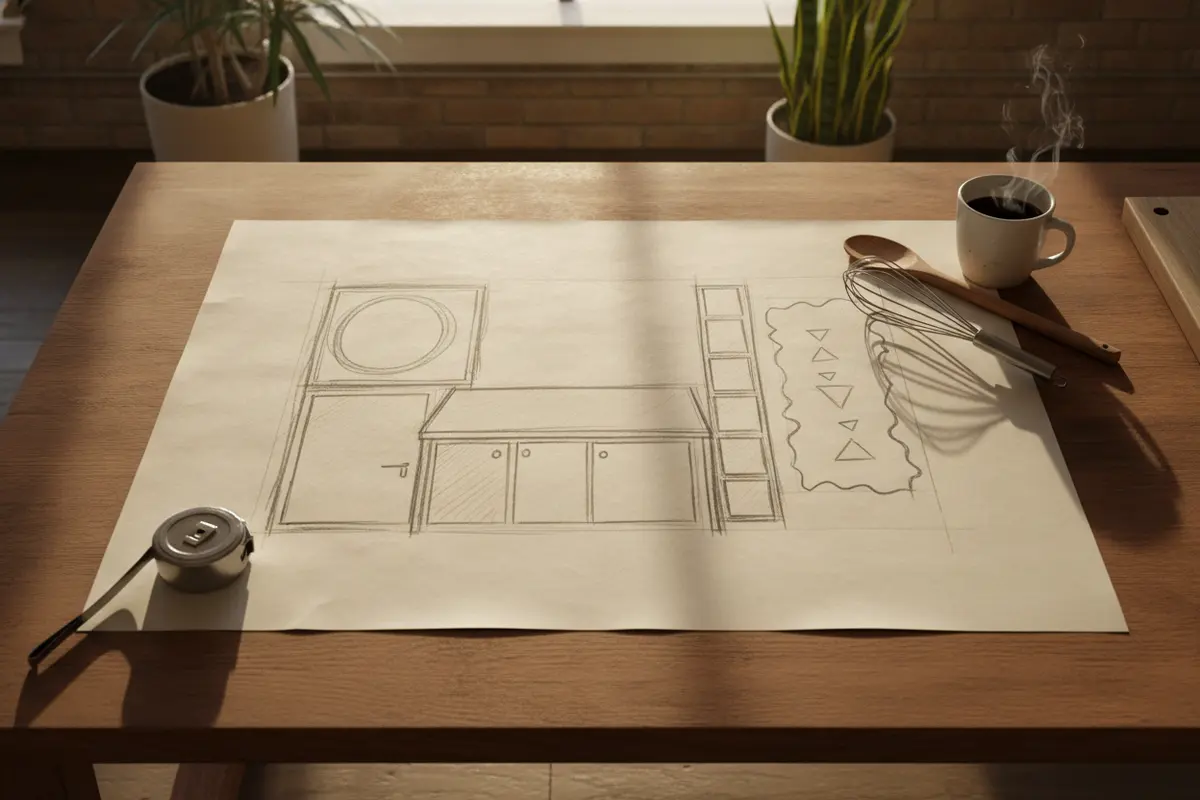
In a smaller kitchen, every drawer needs a clear job. Start with the tools used every day and put them within reach of the main prep area. If there is room for only one utensil drawer, use a tray or dividers to separate the most-used tools from occasional items. Keep the categories broad enough to fit, but not so broad that you have to search through a mixed pile.
Use vertical space carefully. A deep drawer can store bowls or containers, while a shallow upper drawer can keep small tools visible. Do not assume a single large drawer is always the best use of limited cabinetry. A wide drawer without divisions may become cluttered, while several tiny drawers may not fit the cookware or containers you need. Match the configuration to measured items and actual work habits.
In an island or narrow run of cabinets, confirm that drawers can open without blocking an appliance or the main walkway. Consider what happens when another person is cooking or unloading the dishwasher. Drawers are useful only if they remain accessible during normal kitchen activity. If there is not enough storage for every item, move infrequently used tools to a less convenient cabinet or pantry shelf rather than crowding the prime drawers.
Frequently Asked Questions
Are drawers better than lower cabinets for kitchen storage?
It depends on the objects and the user. Drawers can make items visible from above and may reduce the need to reach deep into a cabinet. Lower cabinets can suit tall or bulky items that do not fit well in drawers. Compare the items you store, the available cabinet layout, and how easily household members can lift and retrieve them.
Should kitchen drawers be organized by item or by task?
Task-based groupings often make daily work easier because related tools are stored together near where they are used. Within a task drawer, separate categories such as measuring tools and spatulas so they do not become mixed. Use the approach that makes items easy for everyone in the household to find and put away.
How do I know whether an organizer will fit?
Measure the drawer’s usable interior rather than its outside or cabinet opening. Check the organizer’s full width, length, and height, and account for drawer sides and hardware. Compare those measurements with the tools it will hold, leaving room to lift items out. Confirm the fit before buying a set of inserts.
What should go in a deep kitchen drawer?
Deep drawers can hold pots, mixing bowls, food containers, or larger tools, depending on their interior height and width. Avoid stacking objects so high that the lower items are difficult to reach. Use dividers or pegs where they help keep cookware and lids from shifting.
When should I plan drawer organization during a remodel?
Plan it while the cabinet layout and drawer dimensions are being designed, before those choices are finalized. That gives you time to compare the actual items with the usable space and adjust the design. Inserts can be selected later, but their sizes and the drawer interiors should work together.
Explore kitchen remodeling services
The most effective kitchen drawer organization ideas are the ones that fit your household’s real routines, available space, and daily tools. Build the plan from your inventory and measurements, then choose drawer sizes and dividers that make the finished kitchen easier to use.