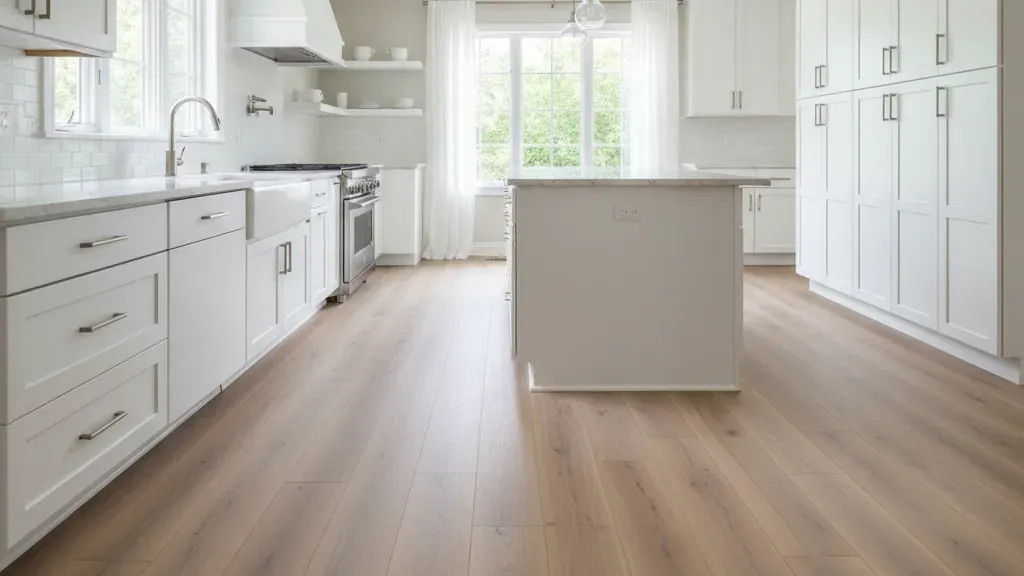
Spills, splashes, steam, and standing water are a daily reality in kitchens and bathrooms. Standard flooring materials absorb moisture over time, leading to warped planks, cracked grout, and mold growth under the surface. The right waterproof flooring stops that cycle before it starts. Our flooring installation services help San Diego homeowners choose materials that fit both rooms, maintaining protection protecting your investment and keeping your home looking sharp for decades. See our guide to waterproof flooring in San Diego for more local material comparisons.
This guide covers the four most practical waterproof flooring options for kitchens and bathrooms: luxury vinyl plank (LVP), porcelain tile, epoxy, and rubber flooring. For each type, you will find honest pros and cons, realistic cost ranges, and guidance on which rooms each material suits best.
Ready to see waterproof flooring options in person? Visit the King Remodeling Design Center in San Diego and touch the materials before you commit.
What Makes a Floor Truly Waterproof?
Not all water-resistant flooring is actually waterproof. “Water-resistant” means the material handles brief exposure without damage. “Waterproof” means the core itself does not absorb water, even with prolonged contact or standing moisture.
The distinction matters most in bathrooms, where floors routinely stay wet for extended periods after showers or baths. In kitchens, the risk is more episodic: spills, dishwasher leaks, and splashes near the sink. Both rooms benefit from fully waterproof materials, but bathrooms demand a higher standard because moisture contact lasts longer.
The four materials covered below are all genuinely waterproof at the core. The differences lie in installation complexity, underfoot feel, price, and aesthetic flexibility.
Luxury Vinyl Plank (LVP): Best All-Around Option
Luxury vinyl plank is the most popular waterproof flooring for kitchens and bathrooms in San Diego right now, and the reasons are straightforward. LVP is 100% waterproof, comfortable underfoot, warmer than tile, and available in realistic wood and stone looks. It works in both rooms without modification.
How LVP Is Constructed
LVP consists of four layers: a rigid WPC (wood plastic composite) or SPC (stone plastic composite) core, a printed design layer, a wear layer, and a backing pad. None of these layers absorb water. If a joint seam gets wet, the water sits on top or drains rather than soaking in. This makes LVP safe for full bathroom installation, including around toilets and showers.
LVP Pros and Cons
| Pros | Cons |
|---|---|
| 100% waterproof core | Can fade in direct sunlight over time |
| Softer and warmer underfoot than tile | Cannot be refinished like hardwood |
| Wide range of realistic wood and stone looks | Lower resale perception than real wood or tile |
| DIY-friendly click-lock installation | Thick planks may create transitions at doorways |
| Lower installed cost than tile | Some budget versions dent or scratch more easily |
| Works over radiant heat systems |
LVP Cost Range
For a San Diego kitchen or bathroom, expect to pay roughly $4-$9 per square foot for the material and $3-$6 per square foot for professional installation. Total installed cost typically lands between $7-$15 per square foot depending on subfloor condition and room complexity. See the LVP installation cost breakdown for a more detailed look at what affects your final number.
Best Applications
LVP works in virtually every kitchen and bathroom layout. It is the go-to choice for homeowners who want the warmth and visual softness of wood in a wet-area room. It also makes sense for households with kids or pets where hard tile feels uncomfortable on bare feet.
Porcelain Tile: Timeless, Durable, Low Maintenance
Porcelain tile has been the standard in bathrooms for generations, and for good reason. Fired at extremely high temperatures, porcelain is one of the densest building materials available. Its water absorption rate is below 0.5%, which classifies it as impervious to moisture under most rating systems.
In kitchens, large-format porcelain tile has grown popular as an alternative to traditional ceramic options, offering cleaner grout lines and a more unified appearance. In bathrooms, porcelain handles shower floors, main bathroom floors, and wall applications.
Porcelain Tile Pros and Cons
| Pros | Cons |
|---|---|
| Virtually impervious to water | Cold and hard underfoot |
| Extremely durable; lasts 50+ years with proper care | Higher installation cost than LVP |
| Hundreds of design options, including wood-look formats | Grout lines require periodic sealing and cleaning |
| Does not fade or scratch easily | Heavier material; some subfloors need reinforcement |
| Adds strong resale value | Harder to DIY; professional installation recommended |
| Works on floors, walls, and shower surrounds |
Porcelain Tile Cost Range
Porcelain tile material costs range from $3-$12 per square foot for standard residential grades, with premium large-format tiles reaching $15+ per square foot. Professional installation, including setting materials and grouting, adds $6-$10 per square foot. Plan for $9-$22 per square foot installed, depending on tile size, pattern complexity, and subfloor preparation required.
Best Applications
Porcelain is the correct choice when longevity and resale value are the top priorities. It is also the only waterproof flooring that can run continuously from bathroom floors up shower walls, creating a unified look. For kitchens with heavy commercial-grade cooking activity, porcelain handles heat and grease better than LVP.
Unsure whether LVP or porcelain tile is right for your project? Talk to the King Remodeling bathroom remodeling team for a free in-home consultation.
Epoxy Flooring: Industrial Strength for High-Performance Kitchens
Epoxy flooring is a two-part resin system applied directly over a concrete slab. Once cured, it forms a hard, continuous surface that is completely non-porous. No grout lines, no joints, no gaps where water can penetrate. This makes epoxy one of the most technically waterproof floor surfaces available.
Epoxy sees heavy use in commercial kitchens and garages because of its chemical resistance and ease of cleaning. For residential applications, it is a strong fit for homeowners who prefer a modern industrial aesthetic or who have a concrete slab foundation and want to avoid raising floor height with additional materials.
Epoxy Flooring Pros and Cons
| Pros | Cons |
|---|---|
| Continuous unbroken surface with zero water infiltration points | Slippery when wet unless non-slip aggregate is added |
| Highly resistant to stains, grease, and chemicals | Requires concrete substrate; not suitable over wood subfloors |
| Easy to clean; no grout lines to maintain | Hard and cold underfoot, similar to tile |
| Long lifespan when properly applied | Requires professional surface preparation for proper bond |
| Customizable colors and decorative flake finishes | Can yellow with UV exposure in sunlit rooms |
| Cost-effective for large open-plan kitchens | Strong odor during installation; room must be vacated |
Epoxy Flooring Cost Range
Residential epoxy flooring typically costs $3-$7 per square foot for materials and $2-$5 per square foot for professional application, including surface grinding and preparation. Total installed cost lands around $5-$12 per square foot. Quality of prep work is the biggest variable. Inadequate prep leads to peeling within a year.
Best Applications
Epoxy is best suited for kitchens with concrete slab foundations, particularly open-plan designs where a single unbroken floor surface is desirable. It works less well in bathrooms because the slip risk is higher, the room tends to be smaller (making large format less impactful), and the installation fumes require extended ventilation that is harder to manage in enclosed spaces.
Rubber Flooring: Comfort-First Waterproofing
Rubber flooring is not yet a mainstream choice in residential kitchens and bathrooms, but it deserves serious consideration for homeowners who spend long hours standing in the kitchen or who need extra slip resistance in a bathroom. Commercial kitchens have used rubber flooring for decades precisely because it is waterproof, slip-resistant, and comfortable underfoot.
Modern residential rubber tiles and rolls have come a long way aesthetically. They are available in solid colors and textured finishes that work well in contemporary or minimalist design schemes.
Rubber Flooring Pros and Cons
| Pros | Cons |
|---|---|
| Excellent slip resistance, even when wet | Limited design options compared to LVP or tile |
| Comfortable underfoot; reduces fatigue during long cooking sessions | Some rubber has a distinct smell, especially when new |
| 100% waterproof | Lower resale appeal than tile or LVP |
| Naturally sound-absorbing and cushioning | Can stain from certain cleaning products |
| Durable; resists denting and tearing | Not suitable for high-heat areas near stoves |
| Often made with recycled materials |
Rubber Flooring Cost Range
Rubber flooring material costs range from $2-$8 per square foot depending on thickness and finish. Installation is often simpler than tile or epoxy, with many products designed for glue-down or loose-lay installation. Total installed cost typically runs $4-$10 per square foot.
Best Applications
Rubber flooring is the right call for kitchen areas where standing comfort and slip safety are top concerns, particularly for households with older family members or people who cook frequently. In bathrooms, it is an excellent option near shower exits or in elderly-care bathroom remodels where fall prevention is a priority.
Side-by-Side Comparison: Which Waterproof Floor Fits Your Room?
| Material | Waterproof Rating | Kitchen Fit | Bathroom Fit | Installed Cost/sq ft | Comfort | Durability |
|---|---|---|---|---|---|---|
| LVP | 100% | Excellent | Excellent | $7-$15 | High | Good (20-25 yr) |
| Porcelain Tile | 100% | Excellent | Excellent | $9-$22 | Low (hard/cold) | Excellent (50+ yr) |
| Epoxy | 100% | Good | Fair | $5-$12 | Low (hard/cold) | Good (10-20 yr) |
| Rubber | 100% | Good | Good | $4-$10 | Excellent | Good (20+ yr) |
Kitchen vs. Bathroom: Different Priorities, Different Choices
Kitchens and bathrooms share the water exposure challenge, but they differ in ways that affect which material makes the most sense.
In kitchens, the floor takes heavy foot traffic, rolling carts and appliances, and episodic large spills. Aesthetic flexibility matters because the kitchen is often the most visible room in the home. LVP and porcelain tile are the strongest performers. Epoxy suits concrete-slab kitchens with a contemporary design direction. Rubber is a practical secondary zone material for cooking-focused households.
In bathrooms, moisture exposure is more prolonged and concentrated. Steam from showers raises humidity throughout the room, which means even walls and subfloors can be affected over time. The floor around the toilet and shower base sees the most water. Porcelain tile is the traditional gold standard. LVP handles bathroom conditions well as long as installation includes waterproof transition strips and careful seam sealing. Rubber is particularly valuable in bathrooms used by older adults or children because of its slip resistance.
For a full bathroom renovation, porcelain tile offers the most cohesive result because it can run from floor to shower walls in a single material. For a kitchen refresh where warmth and comfort are priorities, LVP delivers the best balance of performance and aesthetics. See the complete kitchen flooring guide for a deeper look at all available materials, including options beyond the waterproof category.
Looking at a full kitchen or bathroom renovation? Explore King Remodeling’s kitchen remodeling services and get a fixed-bid quote with no hidden costs.
Installation Considerations for San Diego Homeowners
San Diego’s climate affects flooring performance in one key way: temperature swings between coastal and inland areas. LVP, in particular, expands and contracts with temperature change. A product installed tight against walls in a La Jolla home that stays at 65 degrees year-round will behave differently than the same product in an inland Scripps Ranch home that hits 95 degrees in summer. Choosing LVP with a higher-density SPC core reduces this movement.
Subfloor condition is the other major variable. All four waterproof materials require a flat, clean, and structurally sound subfloor. For epoxy, existing concrete must be profiled (ground or shot-blasted) so the resin bonds properly. For tile, concrete backer board or a quality uncoupling membrane protects against crack transfer. For LVP, high spots above 3/16 inch per 10 feet need to be ground down. Skipping subfloor prep is the most common reason for flooring failures within the first few years.
Permits are generally not required for flooring replacement in California, but if the project includes removing or installing waterproofing membranes in a shower area, that work may fall under bathroom remodeling permit requirements depending on scope. King Remodeling’s team handles permit processing in-house, so you do not need to navigate that process alone.
Frequently Asked Questions About Waterproof Flooring
Is LVP safe for use in bathrooms with a shower?
Yes, LVP is safe in bathrooms that include a shower, provided the installation uses waterproof transition strips at all doorway thresholds and the perimeter is sealed with flexible caulk. LVP should not be installed inside the shower itself. The floor area outside the shower handles moisture from steam and drips without issue.
How long does waterproof flooring last in a kitchen?
LVP typically lasts 20-25 years in a kitchen with normal use. Porcelain tile can last 50 years or more with periodic grout maintenance. Epoxy lasts 10-20 years depending on traffic and quality of the original installation. Rubber flooring generally lasts 20+ years in residential settings.
Can I install waterproof flooring over existing tile?
In many cases, yes. LVP can go over existing tile if the tile is flat, fully adhered, and in good condition. The added height from the existing tile plus the new LVP layer must be accounted for at door thresholds and transitions. Installing over cracked or loose tile is not recommended because the underlying instability will eventually cause problems in the new floor as well.
What is the most slip-resistant waterproof flooring for a bathroom?
Textured porcelain tile with a coefficient of friction rating of 0.6 or higher (DCOF rating above 0.42 for wet surfaces) is the safest option in wet bathroom areas. Rubber flooring is an excellent second option, particularly for households with elderly family members. LVP and epoxy, while waterproof, are smoother underfoot and may require added bath mats or anti-slip treatments in wet zones.
Does waterproof flooring add value to a home?
Yes. Buyers in San Diego’s competitive real estate market respond positively to updated kitchen and bathroom flooring, particularly when the materials are recognizable as durable and water-safe. Porcelain tile historically returns the highest perceived value. LVP has gained strong buyer recognition as a quality material in mid-range and upper-mid-range homes.
Ready to choose your waterproof flooring? Schedule a showroom visit at King Remodeling in Scripps Ranch and see every material option in full size before you decide. Call us at (858) 299-7700 or request a free quote online.