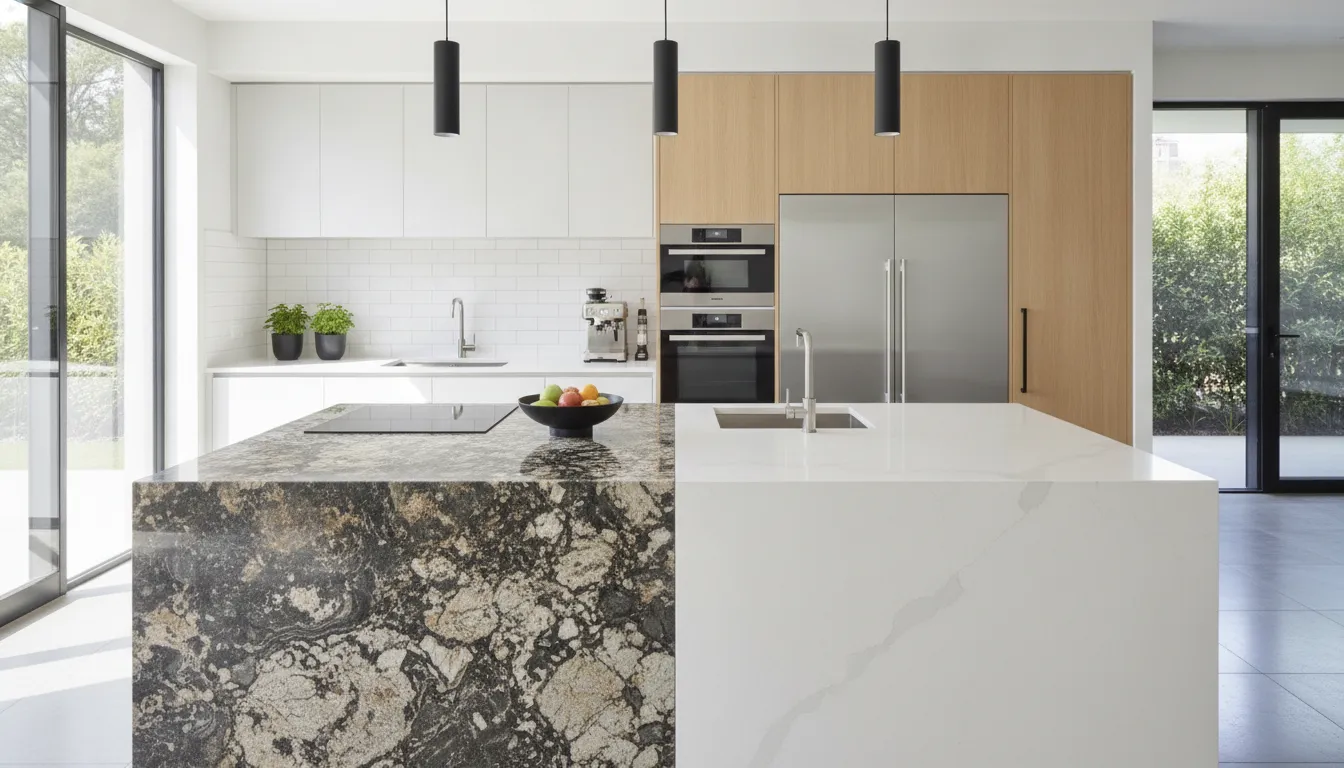
A single red wine spill or a scorching hot pan can permanently scar the wrong kitchen countertop. When planning kitchen remodeling services in San Diego, choosing between natural stone and engineered slabs is your most critical decision. This choice directly impacts your daily cleanup routine, design aesthetic, and home resale value.
Choosing granite vs quartz countertops is the most important choice for your kitchen, directly shaping your daily cleaning routine and overall home value. Natural granite slabs offer unmatched heat resistance and unique patterns, but their porous nature requires regular sealing to block stains and liquid damage. Conversely, engineered quartz countertops combine crushed stone with resin to form a highly durable, non-porous surface that removes any need for sealing. This smooth, uniform surface shrugs off coffee, wine, and oils, but the resin binder remains prone to scorching under direct contact with hot pans. Your final choice depends on whether you prefer the unique organic look of natural stone or the stress-free care of engineered slabs.
Both premium materials offer outstanding beauty, but they function very differently under daily use. To find the right fit for your home, you need a detailed comparison of their care, durability, and overall value. The analysis begins with Granite Vs Quartz Countertops: What’s the Difference?
Granite Vs Quartz Countertops: What’s the Difference?
Choosing the right surface is a major choice for any home project. When planning kitchen remodeling services in San Diego, the debate often comes down to granite vs quartz countertops. While both surfaces look stunning, they have distinct roots, structures, and features.
Origins of natural granite slabs
Granite is a natural, coarse-grained igneous rock that forms from cooled magma deep under the earth’s surface, as noted by Britannica. Quarry workers slice these huge blocks of stone into slabs. Since it comes from nature, each slab has unique pattern and color shades.
The makeup of granite is purely natural. This stone contains minerals like quartz, feldspar, and mica that grow together deep in the earth. As a complex stone, its basic traits can vary from slab to slab, as shown by a study on PubMed. This raw makeup ensures that no man-made process can truly mimic its look.
Manufacturing of engineered quartz countertops
Unlike granite, quartz countertops are engineered. Workers make them by mixing crushed stone with resin binders. This raw mix is shaped through a high-pressure vibro-compaction method that binds the stone with resin to make a dense, non-porous slab. But this process means engineered stone can contain up to 95% crystalline silica by weight, as shown on PMC.
To make these slabs, makers combine crushed natural quartz with resin binders and color dyes. This blend goes through a vibro-compaction process under heavy pressure and high heat. The resin binds the stone tightly, sealing any tiny air pockets. This results in a dense, solid product that resists water and stains far better than raw, unsealed stone.
Key aesthetic differences in the home
Different making methods lead to distinct looks in your home. Engineered quartz offers a consistent pattern that is controlled during making, which makes hiding seams easy. On the other hand, natural granite gives you one-of-a-kind slabs with random veining and color shifts. You can learn more about these features in our guide on choosing the right countertop material for your kitchen.
Durability and Maintenance: Granite vs Quartz Countertops
When choosing the right countertop material for your kitchen, durability and daily care are key factors. Both natural stone and engineered options are big investments that can last for decades in your home. But they handle high heat, spills, and daily wear in very different ways. Knowing how each option works will help you choose the best fit for your kitchen.
Heat and stain resistance
Granite is highly heat resistant because it is a natural rock. This means you can put hot pots and pans right on the surface without any damage. On the other hand, quartz contains plastic resins to bind the crushed stone. These resins can melt or scorch under direct heat, so you must always use hot pads on quartz surfaces.
Stain resistance is another big difference between these two surfaces. Granite is porous, which means it has tiny holes that can absorb liquids if left to sit. You must apply a sealer to prevent staining on natural stone. If granite is unsealed, it can absorb cooking oils, wine, and juices very fast. Quartz is non-porous and never needs a sealer. It resists deep stains from daily kitchen spills with no extra work.
Cracking and daily care
Because granite is natural stone, its physical properties can vary from slab to slab, which affects its strength. Some slabs may have hidden weak spots or tiny cracks. This makes granite more likely to chip if a heavy object falls on it. Quartz is an engineered stone with a very even build. It is less likely to crack because the resin binders add extra flex.
Daily cleaning is simple for both options, but quartz has a clear edge. You can clean quartz using mild soap and water with a soft cloth. Granite is far more sensitive to harsh chemicals. You must avoid acidic cleaners like vinegar or lemon juice, which can dull the polish over time. Granite also needs a sealer when first set up. After that, you must reseal it every one to two years to keep it safe from stains.
Repair difficulty
Even with great care, accidents can happen in any busy kitchen. If you chip or scratch granite, you can often fix it yourself using a color-matched epoxy. While the fixed spot might still be seen, the process is quick and simple. On the other hand, quartz is much harder to fix if it gets damaged. Deep chips or scratches in quartz usually need a pro to fix them.
Comparing maintenance and durability
| Material | Heat Resistance | Stain Resistance | Sealing Needs | Cracking Risk | Daily Cleaning | Repair Ease |
|---|---|---|---|---|---|---|
| Granite | High (takes hot pans) | Porous (needs sealer) | Every 1-2 years | Higher risk on lines | Soap, water (no acids) | Easier with epoxy |
| Quartz | Low (resin can melt) | Non-porous (high resistance) | None | Lower risk (has resins) | Simple soap and water | Harder (needs pros) |
Cost Comparison: Which Countertop Fits Your Budget?
When choosing between granite vs quartz countertops, price is often the main factor for San Diego homeowners. Both options are high-end upgrades, but their price rates differ based on stone sourcing, quality, and design. Knowing these upfront costs is needed when budgeting for your San Diego kitchen remodel. A clear cost breakdown helps you plan your design without spending too much.
Upfront material costs
The base cost of the slabs is the first factor to think about. Entry-level granite often costs from $35 to $45 per square foot. In contrast, engineered quartz starts higher, with baseline options starting at about $60 per square foot. However, the price gap grows when you look at high-end slabs. High-end quartz can max out at about $120 to $130 per square foot. In comparison, rare slabs of natural granite can reach $200 or more per square foot. This cost is due to rare veining. Depending on the brand and design, quartz is sometimes priced higher than granite. Your choice of slab thickness will also affect these raw slab prices.
Installation and fabrication labor
Labor charges are the next big part of your countertop budget. Often, the fully installed price ranges from $50 to $100 per square foot for granite. For quartz, the installed price often runs from $55 to $120 per square foot. Several job-site factors drive these final labor rates. Slabs with complex edge shapes, many sink cutouts, or complex seam layouts need more work to cut. Plus, natural stone can vary in hardness and density across each slab. Cutting and handling natural granite slabs needs expert skill to keep them from cracking. Complex layouts can also increase the hours of work. You will also need sturdy cabinets to hold the heavy weight of the stone.
Long-term value of your investment
Both stone surfaces are excellent choices that can add long-term value to your kitchen. While quartz is tough and needs no routine sealing, granite needs regular care. To keep granite stain-free, you must seal it every one to two years. To prevent price surprises, King Remodeling uses a fixed-bid pricing model. This system gives you a single, set cost for your project from the start. You can visit our Scripps Ranch showroom to touch and compare both stones in person. Our design team can help you find the best countertop for your budget. We will guide you from the first sketch to the final install.
Appearance and Design: Granite vs Quartz Countertops
Choosing the right look for your kitchen counters is a big step. Your choice will set the style for the whole room. Real granite and engineered quartz have their own design traits. One offers raw, wild art, while the other offers clean, steady patterns made by hand.
Natural Stone Patterns in Granite
Natural granite is a raw stone cut from the ground. Each slab has its own unique color and pattern because no two stones are alike. As noted in research on natural stone, granite properties and looks will vary from slab to slab. This means your kitchen will have a look that no other home in the world can copy.
You can also choose how the stone feels. Granite can be finished with a polished, honed, or leathered surface. A polished finish is shiny and bright, while a honed finish is matte and soft. A leathered finish has a rough texture that hides smudges.
These natural looks fit classic San Diego home styles well. They match the warm, rustic feel of Spanish-style homes in La Jolla or Rancho Santa Fe. This style adds a timeless look to any local kitchen.
Steady Styles and Eco-Friendly Quartz
Engineered quartz is made in a different way. It offers a steady look and color pattern that makers can control during the build. Quartz is available in a wider range of colors and patterns than real granite. You can choose bright blues, solid whites, or gold veins that mimic natural marble.
Quartz can also be a green choice for your remodel. Some brands offer eco-friendly quartz options that include recycled glass and other lasting materials. The clean, even style of quartz works great in modern homes. It fits the sleek kitchens found in downtown San Diego lofts or coastal condos.
Comparing Slab Options in Person
Reading about these stones is helpful, but seeing them in person is best. You should touch the different finishes to feel the shift between polished and leathered stone. Seeing full slabs also helps you map out how the patterns will flow across your kitchen. It is hard to judge the depth of these stones from a small online picture.
When you plan your project, think about how the slab fits your lifestyle. Our team can help you find the best match for your home and budget. We provide complete kitchen remodeling services in San Diego. You can see both granite and quartz slabs in person at our Scripps Ranch showroom.
Which Countertop Is Right for Your San Diego Home?
Choosing between granite vs quartz countertops comes down to how you live and use your kitchen. Every home in San Diego has different needs, from busy family hubs to quiet spaces that need low care. Finding the right fit means looking at your daily habits and what each material does best.
Lifestyle and Cooking Habits
Your cooking style is a major factor when choosing between these surfaces. If you are an active cook who bakes often or works with high heat, granite is a great choice. It is a natural stone that handles hot pans directly on the surface without scorch marks. For busy families who want easy cleanups, quartz may be a better option because it does not have pores and never needs sealers. Engineered quartz is made with up to 95% crystalline silica by weight, according to a National Institutes of Health study. These binders make the surface non-porous so it resists stains.
Consider your cleaning habits before you make a final choice. Granite is highly durable, but you must seal it every year or two to keep liquids from soaking in. If you prefer a countertop that only needs mild soap and water for daily cleaning, quartz keeps your kitchen routine simple. If you still cannot decide, you can learn more by exploring other countertop materials to see how they fit into your remodel plans.
Climate and Resale Value Impact
The local climate in San Diego also plays a role in where you install your countertops. If you want to build an outdoor kitchen to enjoy our sunny weather, granite is the clear winner. Granite stands up to UV rays and temperature changes very well. In contrast, quartz is not ideal for outdoor use because direct sunlight can cause the resin binders to fade or turn yellow. For indoor kitchens, however, quartz is perfectly safe from UV damage and is a popular choice for modern spaces.
Both materials are great long-term investments, but they affect home resale value in slightly different ways. Granite is widely regarded as a luxury material that has a strong, high-end appeal with home buyers, as noted in reports on countertop choices. Yet, quartz is fast becoming a favorite for modern buyers who prize its even patterns and simple care needs. Working with a skilled local design-build team ensures you select the choice that helps your home value.
Visit Our Showroom in Person
Reading about these materials is a good start, but seeing them in person makes all the difference. Visiting a design center lets you run your hands over the smooth surfaces and look at full slabs under natural light. Seeing them side by side is the best way to compare the unique grain of natural stone next to the clean patterns of man-made choices. A showroom visit helps you make the right choice for your kitchen design.
Frequently Asked Questions
What is the price difference between granite and quartz countertops?
Granite slabs usually cost between $35 and $200 per square foot installed. Quartz typically starts around $60 and goes up to $130 per square foot. According to Countertop Guides, quartz can sometimes cost more than granite depending on the quality and style. Your total cost will depend on the slab rarity and layout of your kitchen.
Does a granite countertop need to be sealed?
Yes, granite is a natural stone with tiny pores that can absorb liquids and oils. To prevent stains, you must seal it. Industry experts at Countertop Guides state that you should seal granite when you install it. After that, you must reseal the stone every one to two years to keep it protected. Quartz does not need any sealing.
Which countertop is more heat resistant?
Granite is much more heat resistant than quartz. Granite is a natural rock that forms under high heat, so you can place hot pans right on it. Quartz contains plastic resins that can melt or scorch under direct heat. As noted by Countertop Guides, you should always use hot pads or trivets on quartz to avoid permanent damage.
Can you use quartz countertops for an outdoor kitchen?
No, you should not use quartz for outdoor kitchens. The sun has strong light that can damage the resins in quartz. Over time, this light causes the surface to fade or turn yellow. According to Countertop Guides, granite is a better choice for the outdoors because it can handle harsh weather and sunlight without fading.
Are there other kitchen countertop materials I should consider?
Yes, you can look at several options besides granite and quartz. If you want a seamless look with many design choices, try exploring other countertop materials like solid surface. Other great choices for San Diego homes include marble, soapstone, and butcher block. Each option has its own upkeep needs and costs.
Ready to Choose Your Perfect Kitchen Countertops?
Putting off your countertop replacement means continuing to live with stained surfaces, chipped edges, and old designs that make daily cooking and cleaning a chore. Starting your kitchen remodel today ensures our local team can source the best stone slabs and finish your installation before the busy holiday season begins. Booking a free consultation now lets you lock in our fixed-bid pricing to keep your home renovation project completely on budget from start to finish.
Ready to remodel? Call (858) 299-7700 to schedule a free consultation with our design team today. You can also visit our Scripps Ranch showroom to compare premium granite and quartz slabs in person. Our professional builders handle everything from initial design to final polish.