Planning a kitchen remodel in San Diego starts with one question: how much will it actually cost? National averages rarely tell the full story here, where labor demand, coastal building codes, and material availability create pricing that runs 20 to 40 percent above the rest of the country. This guide breaks down real 2026 kitchen remodel costs in San Diego by project scope, individual components, and the local factors that shape your bottom line. Start with a kitchen remodel checklist so each allowance matches the work you actually want done, so you can set a budget grounded in reality rather than guesswork. If countertops are your main scope item, use our kitchen countertop replacement cost guide for a more focused material and installation breakdown.
How Much Does a Kitchen Remodel Cost in San Diego in 2026?
Kitchen remodel costs in San Diego vary widely depending on what you want to accomplish. A cosmetic refresh sits at one end of the spectrum, while a full gut-and-rebuild with structural changes sits at the other. Here is what San Diego homeowners are paying in 2026, based on project scope.
Cost by Project Scope
| Project Scope | Typical Cost Range | What’s Included |
|---|---|---|
| Cosmetic Update | $25,000–$45,000 | New paint, hardware, lighting, backsplash, countertop resurfacing, minor fixture upgrades |
| Mid-Range Remodel | $45,000–$80,000 | New cabinets, countertops, flooring, appliances, lighting, backsplash within existing layout |
| Full Remodel | $80,000–$120,000 | Layout reconfiguration, custom cabinetry, premium materials, new plumbing and electrical |
| Luxury / High-End | $120,000–$200,000+ | Structural changes, wall removal, high-end appliances, custom everything, smart home integration |
The mid-range remodel is the most common project scope in San Diego, where homeowners typically replace all major components within the kitchen’s existing footprint. Most of the kitchens that come through our Design Center fall into this category, with clients balancing quality materials against a realistic budget.
Cost Breakdown by Component
Understanding where your money goes helps you prioritize spending. Here is how a typical mid-range San Diego kitchen remodel breaks down by component.
Cabinetry: $12,000–$35,000
Cabinets typically consume 30 to 40 percent of a kitchen remodel budget, making them the single largest line item. Stock cabinets from big-box retailers start around $100 per linear foot, while semi-custom options run $200 to $500 per linear foot. Fully custom cabinetry, built to your exact specifications, starts at $500 per linear foot and can go much higher depending on wood species and finish complexity.
For San Diego homeowners weighing their options, King Remodeling’s kitchen cabinet replacement service simplifies the process with in-house design guidance and installation.
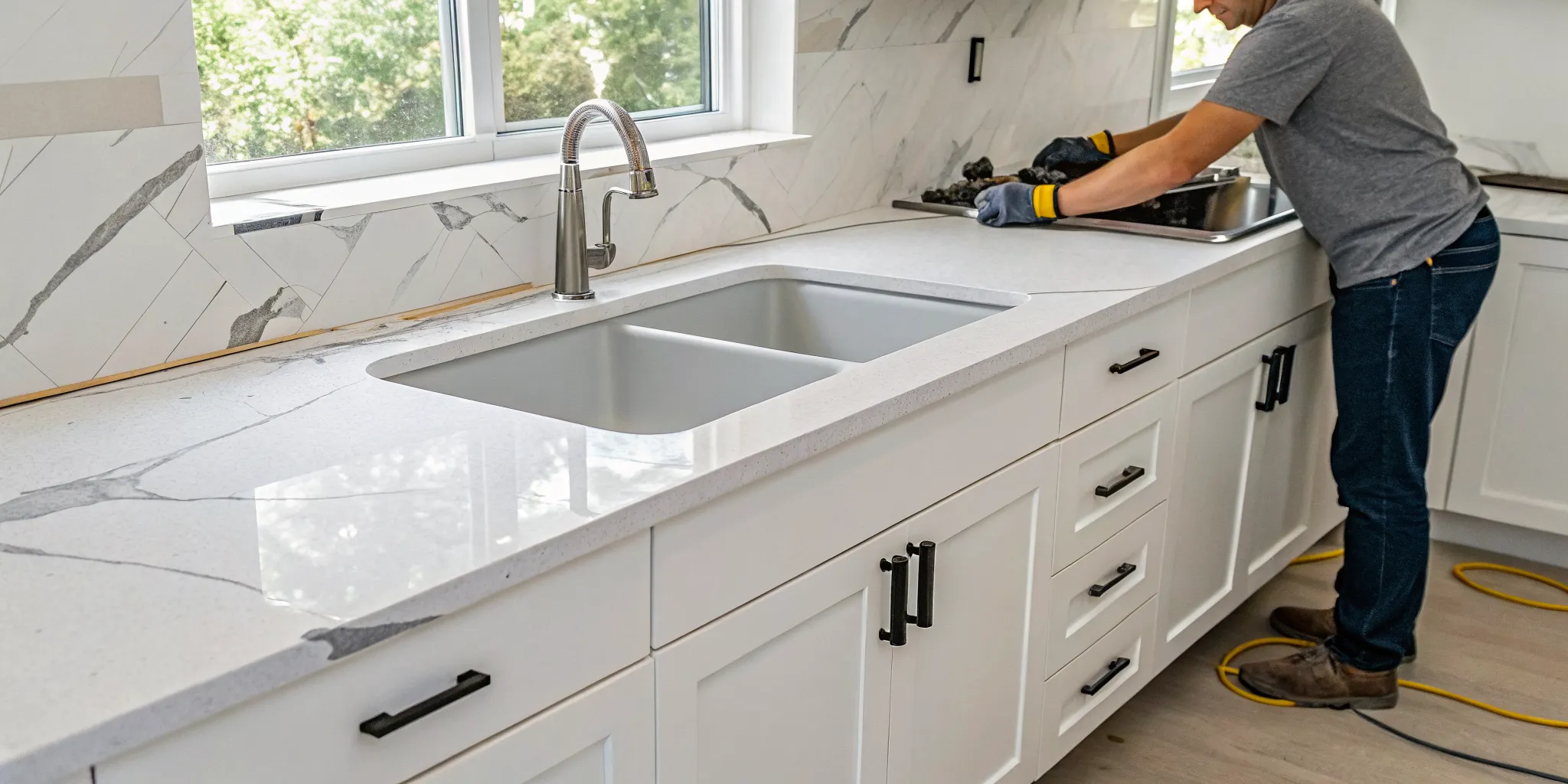
Countertops: $3,000–$15,000
Material selection drives the cost here. Laminate countertops start around $20 per square foot installed, while quartz, the most popular choice in San Diego kitchens, runs $60 to $120 per square foot. Natural stone like granite or marble falls in a similar range, with exotic stones reaching $150 or more per square foot.
Our countertop installation team handles fabrication and installation in-house, which eliminates the markup from third-party fabricators and keeps pricing transparent.
Flooring: $3,000–$10,000
Kitchen flooring costs depend on material and square footage. Luxury vinyl plank (LVP), the fastest-growing choice for San Diego kitchens, runs $5 to $12 per square foot installed. Porcelain tile ranges from $8 to $20 per square foot, while hardwood sits between $10 and $25 per square foot. For a 150-square-foot kitchen floor, budget $1,500 to $3,750 depending on material choice.
Appliances: $3,000–$20,000
Appliance costs vary dramatically by brand tier. A standard suite of mid-range appliances (refrigerator, range, dishwasher, microwave) runs $3,000 to $7,000. Premium brands like Bosch, KitchenAid, or Café push the total to $8,000 to $15,000, while professional-grade appliances from Sub-Zero, Wolf, or Thermador can exceed $20,000 for a full suite.
Labor: $15,000–$40,000
Labor typically represents 25 to 35 percent of total project cost. San Diego labor rates are higher than national averages due to the strong demand for skilled trades in the region. A full kitchen remodel involves multiple trades: demolition, framing, electrical, plumbing, tile setting, cabinet installation, countertop fabrication, painting, and finish carpentry.
Working with a design-build firm that handles all trades in-house eliminates the coordination headaches and markup that come with hiring individual subcontractors.
Plumbing and Electrical: $2,000–$8,000
Moving or adding plumbing lines costs $1,000 to $4,000 depending on complexity. Electrical upgrades, including new circuits for modern appliances, dedicated outlets, and under-cabinet lighting, typically run $1,500 to $4,000. If your home has aluminum wiring or an outdated panel, budget an additional $2,000 to $5,000 for upgrades.
Permits: $500–$2,000
The City of San Diego requires permits for structural changes, electrical work, plumbing modifications, and gas line alterations. Permit fees range from $500 to $2,000 depending on the scope of work. A licensed contractor handles the permitting process as part of the project.
San Diego-Specific Factors That Drive Kitchen Remodel Costs
The San Diego Premium
Remodeling in San Diego costs 20 to 40 percent more than the national average. Several factors create this premium:
- Labor demand. San Diego’s construction market stays busy year-round thanks to consistent population growth and a strong housing market. Skilled tradespeople command higher rates here than in most other metro areas.
- Coastal building codes. Homes near the coast often face stricter requirements for moisture resistance, ventilation, and energy efficiency. These codes add cost but protect your investment long-term.
- Material logistics. While San Diego has excellent access to materials, custom and specialty items sometimes carry longer lead times and higher shipping costs compared to cities closer to major manufacturing hubs.
- Permit requirements. San Diego’s Development Services Department has specific requirements that can add time and cost, particularly for projects involving structural modifications.
Neighborhood Cost Variations
Where you live in San Diego County affects your remodel cost. Projects in La Jolla, Del Mar, and Rancho Santa Fe tend to run 15 to 25 percent higher than projects in inland communities like Poway, Scripps Ranch, or Santee. This reflects differences in home values, client expectations for finish quality, and in some cases, additional HOA or architectural review requirements.
How to Set a Realistic Kitchen Remodel Budget
Step 1: Define Your Scope
Before you start collecting quotes, get clear on what you want to change. Are you keeping the existing layout and upgrading surfaces and appliances? Or are you reconfiguring the space, moving walls, or adding square footage? The answers to these questions determine which cost tier your project falls into.
Step 2: Allocate by Component
Use the percentage-of-budget approach as a starting framework:
| Component | % of Total Budget |
|---|---|
| Cabinetry | 30–40% |
| Countertops | 10–15% |
| Flooring | 5–10% |
| Appliances | 10–20% |
| Labor | 25–35% |
| Plumbing / Electrical | 5–10% |
| Permits / Design | 3–5% |
These percentages overlap intentionally because labor is embedded in several categories. Use them as guardrails rather than exact targets.
Step 3: Build in Contingency
Set aside 10 to 20 percent of your total budget for unexpected discoveries. Older San Diego homes, especially those built before 1980, often have surprises behind the walls: outdated plumbing, insufficient electrical capacity, or hidden water damage. A contingency fund covers these issues without derailing your project.
Step 4: Get Fixed-Bid Estimates
Avoid hourly or cost-plus pricing models that leave your final number open-ended. A fixed-bid estimate locks in your total cost before work begins, so there are no surprises on the back end. King Remodeling provides fixed-bid pricing on every project as part of our transparent process.
Kitchen Remodel ROI: What You Get Back
A kitchen remodel is one of the highest-ROI home improvement projects you can undertake. According to the National Association of Realtors’ 2025 Remodeling Impact Report, homeowners in the Pacific region recoup 75 to 85 percent of a mid-range kitchen remodel at resale. For a $60,000 remodel, that translates to $45,000 to $51,000 in added home value.
Beyond resale value, a kitchen remodel improves daily quality of life. The same NAR report found that 95 percent of homeowners who completed a kitchen remodel reported increased enjoyment of their home.
In San Diego’s competitive housing market, an updated kitchen can also reduce time on market and attract stronger offers when it comes time to sell.
Common Kitchen Remodel Mistakes That Blow the Budget
- Changing the layout after demolition. Moving walls, plumbing, or electrical after work has started triggers expensive change orders. Finalize your layout before the first hammer swings.
- Underestimating appliance lead times. Premium appliances can have 8 to 16 week lead times. Order early or risk holding up the entire project.
- Skipping the contingency fund. Homeowners who skip the 10 to 20 percent contingency end up cutting corners on finishes when unexpected issues arise.
- Hiring the lowest bid. The cheapest estimate often signals corners being cut on materials, labor quality, or insurance coverage. Compare scope and inclusions, not just price.
- Making material selections during construction. Decisions made under time pressure tend to be expensive decisions. Choose all your materials before construction begins, ideally at a showroom where you can see everything together.
How King Remodeling Keeps Kitchen Costs Predictable
The biggest source of budget overruns in kitchen remodeling is coordination failure: the designer specifies one thing, the material supplier delivers another, and the contractor has to improvise. This happens when you are managing three or four separate companies.
King Remodeling eliminates this problem by handling design, materials, and construction under one roof. Here is how the process works:
- In-home consultation to assess your space, discuss goals, and establish a preliminary budget range.
- Design Center visit to select cabinets, countertops, flooring, and finishes in person. You see and touch everything before committing.
- Fixed-bid proposal with a detailed scope of work, material specifications, and a guaranteed total price.
- In-house construction with a dedicated project manager who keeps you updated throughout the build.
Every King Remodeling kitchen project includes a 2-year workmanship warranty and a clean jobsite guarantee, because we know you are living in your home while the work happens.
Frequently Asked Questions About Kitchen Remodel Costs in San Diego
How much does a kitchen remodel cost in San Diego in 2026?
A kitchen remodel in San Diego costs between $25,000 and $200,000+ in 2026, depending on scope. Cosmetic updates run $25,000 to $45,000, mid-range remodels cost $45,000 to $80,000, full remodels range from $80,000 to $120,000, and luxury projects start at $120,000.
Why is kitchen remodeling more expensive in San Diego?
San Diego kitchen remodels run 20 to 40 percent higher than national averages due to strong labor demand, coastal building code requirements, material logistics, and local permit processes. These factors add cost but protect the quality and longevity of your investment.
How long does a kitchen remodel take in San Diego?
Most kitchen remodels in San Diego take 6 to 16 weeks depending on scope. A cosmetic refresh may take 6 to 8 weeks, while a full remodel with layout changes typically runs 12 to 16 weeks. Permit timelines in San Diego can add 2 to 4 weeks depending on project complexity.
What percentage of home value should I spend on a kitchen remodel?
A common guideline is to invest 5 to 15 percent of your home’s current value. For a $800,000 San Diego home, that puts the ideal remodel budget between $40,000 and $120,000. This range ensures your kitchen matches the rest of the home without overimproving for the neighborhood.
Can I remodel a kitchen in phases to spread out costs?
Yes, phased remodeling is possible but requires careful planning. Common phases include cabinets and countertops first, followed by appliances and flooring later. However, phasing often costs 10 to 20 percent more total because trades have to mobilize multiple times and protective measures must be repeated. Discuss phasing with your contractor before committing to this approach.
o?You need a permit for any work involving structural changes, electrical modifications, plumbing alterations, or gas line work. Cosmetic updates like painting, new hardware, or countertop replacement typically do not require permits. Your contractor handles the permitting process.
What is the most expensive part of a kitchen remodel?
Cabinetry is typically the most expensive component, consuming 30 to 40 percent of the total budget. For a mid-range San Diego kitchen remodel, expect to spend $12,000 to $35,000 on cabinets alone. Labor is the second-largest cost category at 25 to 35 percent of the total project cost.
Is a kitchen remodel worth it in San Diego?
Yes. San Diego homeowners typically recoup 75 to 85 percent of their kitchen remodel investment at resale. Beyond financial return, updated kitchens increase daily enjoyment and can reduce energy costs with modern appliances and improved lighting.
Do I need a permit for a kitchen remodel in San Diego?
You need a permit for any work involving structural changes, electrical modifications, plumbing alterations, or gas line work. Cosmetic updates like painting, new hardware, or countertop replacement typically do not require permits. Your contractor handles the permitting process through the City of San Diego Development Services Department.