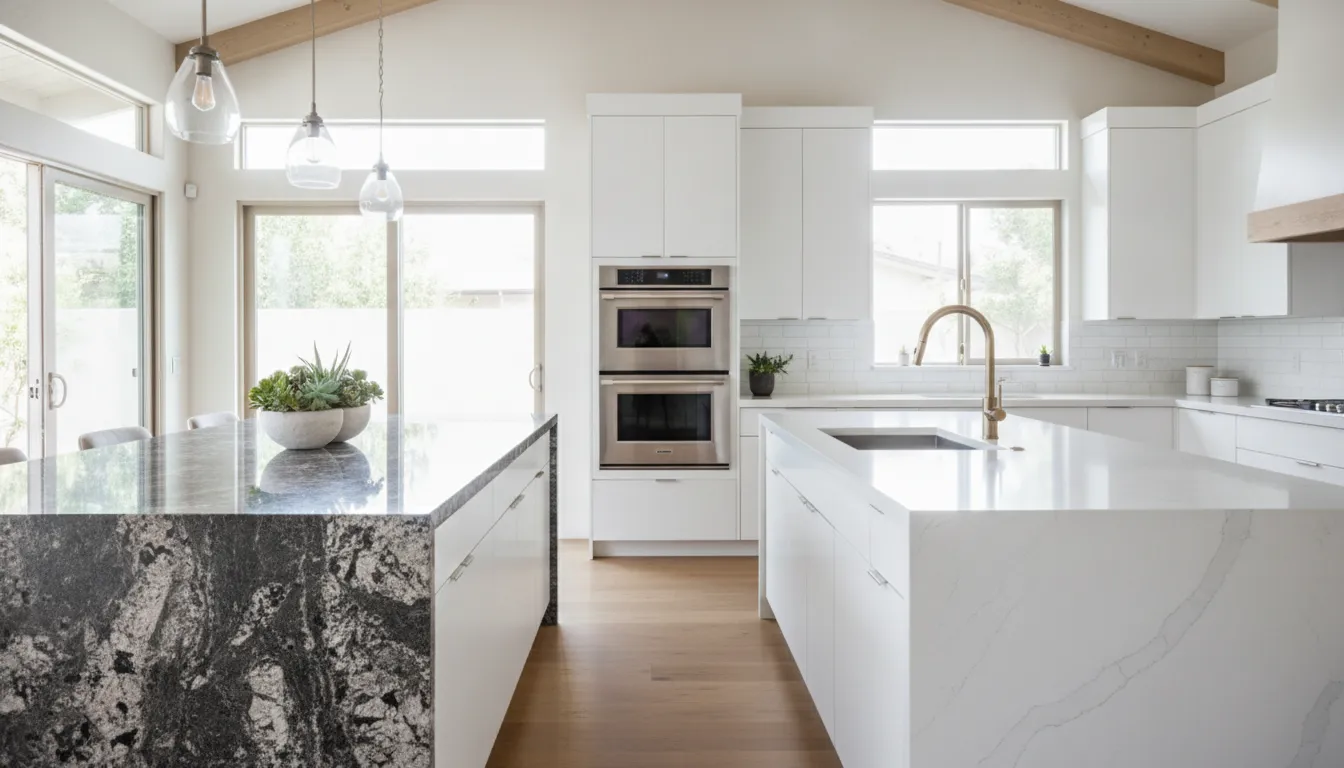
Choosing the wrong kitchen countertop material can lead to years of regret and expensive repairs. Slabs of natural stone and engineered surfaces look beautiful on display, but daily life in a busy kitchen soon tests their limits. Deciding between these two leading options requires a clear look at how they handle heat, spills, and daily wear.
Ready to explore your options? Visit our San Diego showroom to see granite and quartz slabs up close and get expert guidance on the best fit for your kitchen.
When comparing granite vs quartz countertops, the best choice depends on your daily kitchen habits and maintenance preferences. Granite countertops are natural stone slabs cut directly from the earth, offering one-of-a-kind patterns and excellent heat resistance, though they need periodic sealing to prevent stains. Quartz countertops are engineered stone surfaces made of about 93% quartz crystals mixed with resins, making them non-porous, highly stain-resistant, and entirely maintenance-free. While granite appeals to those who want a unique, natural look that handles hot pans directly. Quartz is the better option for homeowners who prioritize low maintenance and design consistency. Both materials provide long-term durability and boost home resale value, but their care requirements and styles differ significantly.
Before making your final choice, it is essential to look at how each material fits your kitchen layout and cooking style. Let’s start by looking at Granite vs Quartz Countertops: Understanding the Core Differences to see how they are made and why they perform so differently in your home.
Granite vs Quartz Countertops: Understanding the Core Differences
Choosing the right material for your kitchen countertop replacement project is a major decision. The two most popular choices today are granite and quartz. While they may look similar on the surface, they are very different materials with distinct origins, manufacturing processes, and physical traits. Understanding these basic differences is the first step toward finding the perfect fit for your home.
What Is Granite Countertop Material?
Granite is a natural stone material mined directly from the earth and cut into solid slabs, as described in resource guides by the University of Washington. This igneous rock forms deep underground over millions of years as magma cools and hardens under immense pressure. Because it is a pure product of nature, every piece of granite is entirely unique. Slabs are quarried from deep pits, sliced with large diamond saws, and polished to a high shine. There are no synthetic chemicals or additives used in this process, making each slab a one-of-a-kind work of natural art with its own distinct mineral patterns and colors.
What Is Quartz Countertop Material?
Quartz is an engineered stone surface. It is a man-made product typically composed of about 93% ground natural quartz crystals mixed with roughly 7% polymer resins, binders, and color pigments. Unlike granite slabs which are cut straight from the earth, quartz surfaces are manufactured in a factory. The raw quartz minerals are crushed and blended with the liquid resin. This mixture is poured into a mold, compressed under high pressure, vacuumed, and baked at high heat to create a solid, non-porous slab. If you want to learn more about this material, you can read our guide on quartz countertops in depth before planning your kitchen remodel.
How the Creation Process Sets Them Apart
The core difference between these two surfaces lies in how they are made. Granite slabs are 100% natural, while quartz countertops are engineered. This difference affects everything from their internal structure to how they perform in your kitchen. Because quartz is bound together with resins, it lacks the natural pores, fissures, and microscopic cracks found in natural granite. However, because quartz is man-made, the fabrication of engineered stone can pose serious health risks to factory workers. Specifically, exposure to crystalline silica dust during cutting can cause lung disease if strict safety protocols are not followed, a critical health concern documented by the National Institutes of Health (NIH).
Key Features of Natural vs Engineered Surfaces
To help you compare these options for your kitchen countertop replacement project, here is a quick look at their basic traits:
- Composition: Granite is 100% natural volcanic rock, while quartz is a mix of natural minerals and synthetic resins.
- Uniqueness: Every granite slab has a unique pattern, while quartz has a uniform and repeatable design.
- Porosity: Granite is naturally porous and requires a sealant, while quartz is completely sealed by its resin binder.
- Manufacturing: Granite is quarried and sliced, while quartz is mixed, molded, and baked.
Cost Comparison: How Much Do Granite and Quartz Countertops Cost?
Budget is a main factor when you plan a kitchen countertop replacement project. When you choose between a granite or quartz countertops layout, understanding the cost structure helps you make the right choice. Both materials offer great value, but their price points depend on different factors. Here is a clear breakdown of what you can expect to pay for each material.
The Price Range of Granite Countertops
Granite is a natural stone, so its price changes based on how rare the slab is. Entry level granite can start at about $35 to $45 per square foot, as noted by Pinnacle Stone Care. This low cost makes basic granite an easy choice for budget plans. However, rare slabs with unique colors can cost much more. These exotic types of granite can reach prices of $200 or more per square foot. Most homeowners choose mid grade granite, which stays in the middle of this range.
The Price Range of Quartz Countertops
Quartz is an engineered stone, so its pricing is more uniform than natural stone. Basic quartz starts at around $60 per square foot. High grade options from top brands can go up to $130 per square foot. Because quartz uses a factory mix of minerals and resin, you pay for the quality of the mix and the brand. You do not have to pay extra for the rarity of a single natural block, which makes quartz costs easy to plan.
What Affects Your Total Countertop Bill?
The slab price is only one part of your overall kitchen remodel costs in San Diego. Fabrication and setup play a big role in your final cost. A standard installation bill includes several key steps:
- Slab Template: Builders must measure your cabinets with laser tools to make an exact plastic template.
- Fabrication: Pros use big saws to cut the slab and polish the edges to match your kitchen design.
- Cutouts and Seams: Making holes for your sink, cooktop, and faucets requires precise cuts that add to the labor cost.
- Edge Profiles: Basic square edges are free, but premium shapes like bullnose or ogee cost more per linear foot.
Regional labor rates also affect your bill. In San Diego, complex cuts and heavy stone handling require skilled crews. Choosing complex edge shapes or choosing thick slabs will raise your final setup price.
Durability and Heat Resistance: Which Countertop Lasts Longer?
When you plan a kitchen remodel, you need a surface that can handle daily wear. Scratching, chipping, staining, and high heat are all common threats in a busy home. Both options perform well, but they have different strengths under pressure. When looking at granite vs quartz countertops, the best choice depends on how you use your kitchen.
Which Material Resists Stains and Scratches Best?
If you want a surface that resists stains and scratches with very little effort, quartz is the clear winner. Quartz is a manufactured stone made with resins, making it non-porous. This means common liquids like red wine, coffee, or juice will not soak into the surface or leave permanent marks. According to academic research, quartz is more resistant to stains and scratches compared to natural stone.
This non-porous nature also gives quartz a slight edge in scratch resistance. It holds up well against knives and heavy pans, though you should still use a cutting board. If you want to learn more about choosing the best surface, read our replace kitchen countertops guide for deep comparisons of each option.
How Do Quartz and Granite Handle High Heat?
While quartz excels at stain resistance, granite is the superior choice for handling high temperatures. Granite forms under intense heat and pressure deep within the earth, allowing it to easily withstand hot pots and pans. You can take a hot baking sheet straight from the oven and set it on a granite slab without causing damage.
Quartz countertops cannot handle the same extreme heat because of how they are made. The resins used to bind the quartz crystals can melt or discolor when exposed to high heat. While both materials are heat-resistant, granite can withstand higher temperatures than engineered stone. If you place a hot pan directly on a quartz surface, you may leave a permanent burn mark. You must use trivets or hot pads with quartz to keep the surface safe.
A Quick Look at Daily Durability
To help you decide between these two popular materials, here is how they compare across key daily challenges:
- Stain Defense: Quartz wins because it is non-porous and never needs sealers.
- Heat Defense: Granite wins because it easily handles hot pots without scorch marks.
- Scratch Defense: Both are highly durable, but quartz is slightly harder to scratch.
- Chip Defense: Both can chip if hit by a heavy object, but professional repairs are simple.
To see these differences in person, visit a local showroom or read our guide on comparing countertop materials to find the perfect fit for your home.
Maintenance: Comparing Granite and Quartz Care Requirements
Kitchen counters see heavy use every day. To keep them looking new, you must understand their upkeep needs. The main differences between granite and quartz lie in how they handle spills and long-term care. While daily cleaning is similar for both materials, their periodic needs are very different.
The Realities of Granite Sealing
Granite is a natural stone that comes directly from the earth. Because it is a natural material, it is porous and has tiny pores that can soak up liquids. To protect your investment, granite requires periodic sealing to maintain its durability and resist deep stains. Without a sealer, oil, wine, and juice can seep into the stone and leave permanent marks.
Most home experts recommend that you seal granite every one to two years. If you want to do the work yourself, a bottle of stone sealer costs about 30 to 50 dollars. If you hire a professional, the service can cost between 150 and 300 dollars each time. This added cost is a key factor when comparing long-term expenses.
The Low-Maintenance Appeal of Quartz
In contrast, quartz is an engineered stone made of mineral crystals and resin binders. This man-made structure makes quartz completely non-porous. Since there are no pores, quartz is more resistant to stains and never needs to be sealed. You do not have to worry about water spots or food dyes soaking into the surface, which makes it a great fit for busy kitchens.
If you want to understand how quartz behaves, you can read our guide on quartz countertops in depth. Its surface naturally blocks out liquids and resists scratches from everyday kitchen tools. This low-maintenance quality saves you both time and money over the lifespan of your kitchen.
Daily Cleaning and Products to Avoid
For daily cleaning, both materials are easy to manage. You can clean both granite and quartz with mild dish soap and warm water. A soft microfiber cloth is all you need to wipe away crumbs and light grease. However, you must use the right cleaning products to prevent surface wear.
For granite, avoid acidic cleaners like vinegar, lemon juice, or window sprays. Acid can eat away at the protective sealer and dull the stone. For quartz, you must avoid harsh chemical solvents, bleach, and abrasive pads. These chemicals can break down the resin binder that holds the quartz crystals together, leaving a cloudy or damaged spot on the finish.
- Daily Care: Wipe both surfaces with mild soap, warm water, and a soft cloth after cooking.
- Periodic Upkeep: Apply a stone sealer to granite every 12 to 24 months, while quartz requires zero sealers.
- Long-Term Cost: Budget 150 to 300 dollars per year for professional granite sealing, or do it yourself for under 50 dollars.
Appearance and Design: Natural Stone vs Engineered Elegance
The look of your kitchen depends highly on the countertop you choose. Choosing between granite and quartz means comparing natural patterns with manufactured designs. Each option offers a distinct style for your home remodeling project.
Unique Slabs and Natural Veining in Granite
Granite is a natural stone cut straight from the earth, meaning no two slabs are ever the same. Each piece has its own unique veining, pits, and color changes that occurred over years of heat and pressure. If you want a kitchen that looks completely one of a kind, granite offers that raw beauty. When comparing countertop materials, many homeowners fall in love with the depth and character that only real stone can provide.
You can find granite in shades of deep gray, warm brown, soft gold, and classic white. However, the colors are limited to what nature creates. The patterns can also vary wildly across a single slab, which makes matching seams during installation a task for skilled pros. To get the best look, you must select the exact block of stone you want before fabrication begins.
Consistent Style and Color Range with Quartz
Quartz countertops are made by mixing ground quartz crystals with resins and pigments to create highly uniform surfaces. This engineering process gives you complete control over the design, color, and pattern. If you like the clean look of marble but want better durability, quartz can mimic those soft gray veins perfectly without the staining risks. It is a popular way to ensure your design remains cohesive across the entire room.
Because it is manufactured, quartz offers a wide range of solid colors, bright whites, and modern concrete styles. You do not have to worry about surprise spots or sudden color shifts in the middle of your counter. When pairing cabinets with your countertops, quartz makes it simple to coordinate the tones for a balanced kitchen style.
Key Visual Differences for Homeowners
To help you choose the right style for your home, consider these main design traits:
- Pattern flow: Granite has random, natural patterns, while quartz offers predictable, repeatable designs.
- Color choices: Quartz can be made in almost any shade, whereas granite is limited to earthy, natural tones.
- Seam matching: It is easier to hide seams on quartz countertops because the pattern is so consistent.
Not sure which look fits your home? Contact King Remodeling to schedule a showroom visit and see both materials in person.
We invite San Diego homeowners to visit the King Remodeling showroom to see these visual differences in person. Touching the polished surface of granite and feeling the smooth finish of quartz under true light is the best way to choose. If you want to check your options, you can read more about standard engineered stone qualities or visit our design center today.
Resale Value: Do Granite or Quartz Countertops Add More Value to Your Home?
When you update your kitchen, choosing between granite and quartz countertops is a major decision. Both high-end surfaces are top choices for boosting home value. But home buyers often view them in different ways. Granite has long been the gold standard for luxury homes because of its natural, one of a kind look. At the same time, quartz is gaining ground fast due to its low maintenance appeal.
Market Perception and Home Buyer Preferences
Modern home buyers love both materials, but they value different traits in each one. Many buyers still prefer the prestige of real, mined stone. They appreciate that every granite slab is unique. Other buyers favor quartz because it does not need regular sealing to stay beautiful. They want a home that is move-in ready and easy to clean. If you plan to sell soon, it is smart to look at how local markets react to each material.
San Diego Real Estate and Return on Investment
In the competitive Southern California market, updated kitchens can drive much higher offer prices. Buyers expect premium finishes when they tour local homes. To understand how these material choices fit into a full project budget, you can review kitchen remodel costs in San Diego. Most homeowners see a strong return on investment when they choose either surface over older laminate or tile. Your ROI often depends on the overall style of your home and what nearby buyers expect.
Key Factors That Affect Countertop Resale Value
The total value these materials add to your property depends on several key points:
- Color trends: Neutral, bright colors often appeal to a wider group of home buyers.
- Consistency: Buyers who want a modern look prefer the uniform patterns of quartz.
- Durability: Busy families tend to value the stain resistance of non-porous quartz surfaces.
- Natural appeal: Buyers of high-end homes often expect the organic patterns found in real granite.
According to research from the National Institutes of Health, engineered stones like quartz require specialized handling during fabrication due to silica dust, but once installed, both options provide safe, highly durable work surfaces that buyers trust. Selecting the right color and pattern that matches your cabinets will help you get the best return on your kitchen remodeling investment.
Granite vs Quartz Countertops: A Side-by-Side Comparison
When planning a kitchen renovation, choosing the right surface is a major decision. Both materials are highly durable, but they have key differences in cost, care, and heat resistance. Looking at a direct comparison can help you find the best option for your daily kitchen needs.
| Feature | Granite Countertops | Quartz Countertops |
|---|---|---|
| Material Type | Natural stone mined from the earth. | Engineered stone made of 93% quartz crystals and resin. |
| Cost Range ($/sqft) | Starts at $35 to $45, but rare types can reach $200 or more. | Starts at around $60, up to $130 per square foot. |
| Durability | Very hard, but can chip if hit with a heavy object. | Highly resistant to scratches and chips. |
| Heat Resistance | Excellent; can withstand direct heat and hot pans. | Moderate; resin can melt or discolor from high heat. |
| Stain Resistance | Porous; needs sealing to prevent liquid damage. | Non-porous; naturally resists liquids and spills. |
| Maintenance | Requires periodic sealing and daily gentle cleaning. | Low maintenance; never needs sealing. |
| Appearance Variety | Each slab is unique with natural color shifts. | Consistent patterns and wide color options. |
| Resale Value | High appeal; sought after by home buyers. | High appeal; matches modern design trends. |
Which Countertop Material Should You Choose?
The choice between granite vs quartz countertops comes down to your personal habits and style goals. If you cook often and place hot pans directly on the surface, granite is an excellent option. Its natural, one-of-a-kind look cannot be fully matched by man-made products. You must be willing to seal the surface every few years to protect it from stains.
If you prefer a low-maintenance home, quartz is the better path. It resists stains and never needs sealing, making it ideal for busy homes. The engineered structure also ensures a uniform look across your whole kitchen. You can learn more about how these options fit your budget by checking kitchen remodel costs in San Diego before starting your project.
Frequently Asked Questions
Which is a better countertop, quartz or granite?
Neither material is universally better, as the choice depends on your lifestyle and design preferences. Quartz is a manufactured material that resists stains and does not need sealing, making it ideal for busy kitchens. Granite is a natural stone cut from the earth, offering unmatched heat resistance and unique, organic patterns that engineered slabs cannot match.
What are the negatives of quartz countertops?
The main downside of quartz is its limited heat resistance. Unlike granite, the resins used to bind engineered quartz can scorch or discolor if you place hot pans directly on the surface. Additionally, quartz is not UV-resistant, meaning direct sunlight from kitchen windows can fade its colors over time.
Why is quartz highly popular for modern kitchens?
Quartz remains highly popular because it is non-porous and extremely low maintenance. Unlike natural granite, which needs regular sealing to block stains, quartz never requires sealing to stay clean. Homeowners also appreciate its consistent color patterns, which make it easy to hide seams during installation.
Is granite or quartz cheaper to install?
According to cost data shared by Pinnacle Stone Care, entry-level granite starts around $35 to $45 per square foot, while quartz typically starts higher at about $60 per square foot. However, rare or exotic granite slabs can quickly exceed $200 per square foot, making quartz more cost-effective for high-end look comparisons.
Ready to Choose Your Ideal Countertops?
Delaying your kitchen upgrade can lead to rising material prices, prolonged design stress, and ongoing daily frustration in your cooking space. Deciding on countertops early helps keep your kitchen remodeling timeline on track, avoids unexpected installation delays, and ensures a smooth, stress-free renovation project. Seeing these surfaces under real design-center lighting is the only way to pick the perfect texture, color, and finish for your daily lifestyle. Choosing the right slab early means your renovation stays on schedule, and you can enjoy your stunning, highly functional new culinary space much sooner.
Ready to start? Visit our San Diego showroom to see granite and quartz countertops in person to make your choice with confidence.